 Gallopa
Horse Gaits Explained: Walk, Trot, Canter and Gallop
- The Four Horse Gaits at a Glance
- Horse Gaits Chart
- Walk: the Four-Beat Gait Riders Underrate
- Types of Horse Walks
- Trot: Two Beats and a Moment of Flight
- Canter: Three Beats and a Lead
- Canter vs Gallop: What Actually Changes
- Horse Gait Speed Table
- Beats Per Gait: The Footfall Sequences
- Gaited Horses: When the Rulebook Changes
- Learning to Feel Each Gait
- FAQ
Every ride you will ever sit comes down to four patterns of footfalls: walk, trot, canter and gallop. Riders use the words daily, yet plenty of us would hesitate to explain what actually changes underneath us when a horse moves up a gait. Understanding the beats is not trivia. It is how you keep rhythm, spot soundness problems early and make sense of any gait analysis of your rides.
The Four Horse Gaits at a Glance
A gait is simply a repeating pattern of footfalls. The walk is a four-beat gait, the trot a two-beat gait, the canter a three-beat gait and the gallop a four-beat gait again, each with its own rhythm, speed range and feel. Speed alone never defines the gait: a lazy canter can be slower than a strong trot. The footfall pattern is what changes.
| Gait | Beats | Typical speed | How it feels |
|---|---|---|---|
| Walk | 4 | 6 to 7 km/h (about 4 mph) | Steady sway, no bounce, you can feel each hind leg step under |
| Trot | 2 | 10 to 15 km/h (6 to 9 mph) | Springy and bouncy, the reason rising trot exists |
| Canter | 3 | 16 to 27 km/h (10 to 17 mph) | Rocking, roll-along rhythm with a clear "da-da-dum" |
| Gallop | 4 | 40 to 48 km/h (25 to 30 mph) | Flat, fast and urgent, the horse stretches long and low |
The speed ranges overlap on purpose. A big warmblood's working trot can outpace a pony's quiet canter, which is exactly why gait tracking that relies on GPS speed alone gets it wrong, and why Gallopa also reads the rhythm of your movement to tell a brisk trot from a slow canter.
Horse Gaits Chart
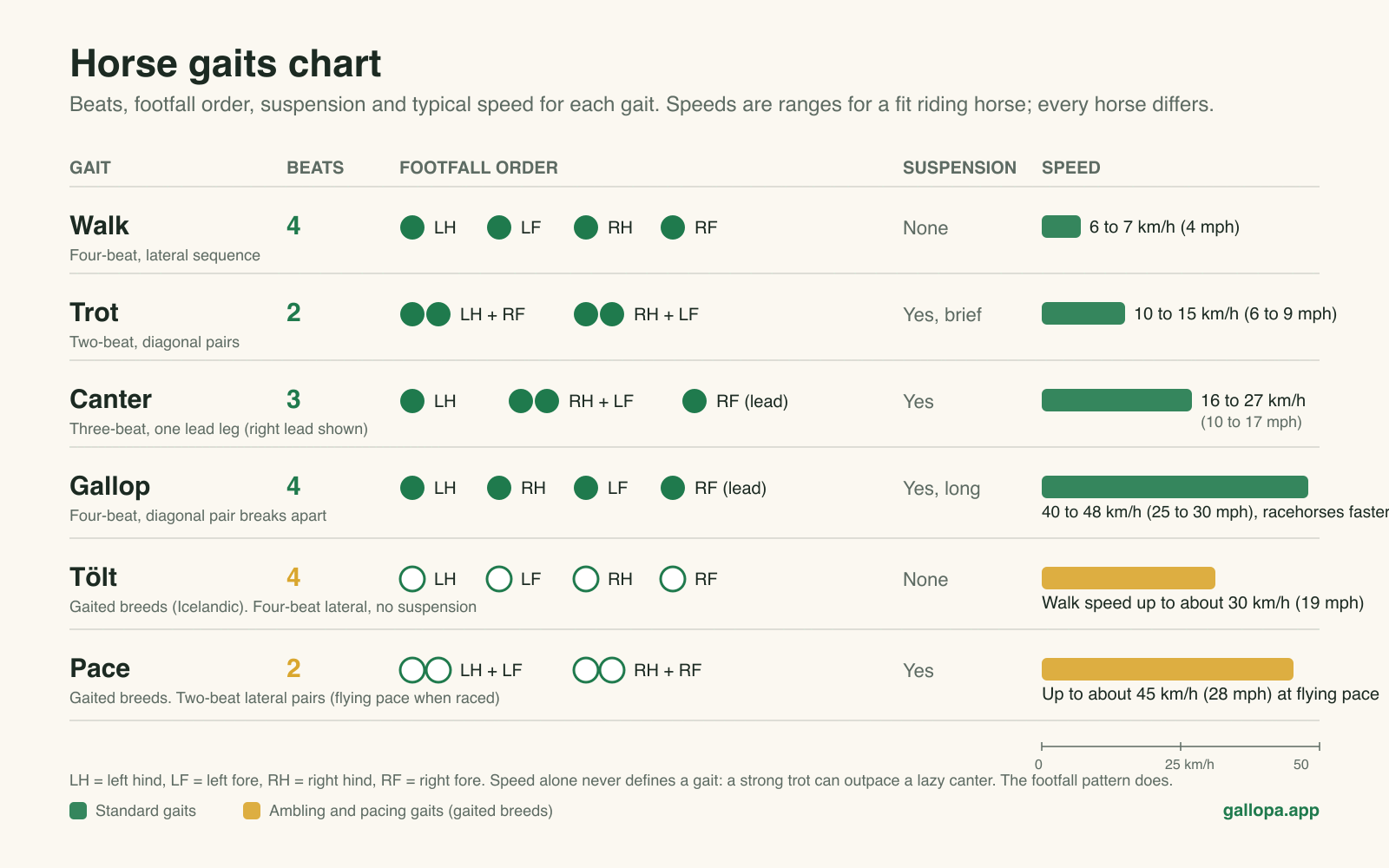
The chart shows the four standard gaits plus the tölt and the pace on one page: the footfall pattern, the beats you count from the saddle and the usual speed range in km/h and mph. The beats define the gait; the speeds are only typical. Save it to your phone for the yard.
Walk: the Four-Beat Gait Riders Underrate
The walk is a four-beat lateral sequence: left hind, left fore, right hind, right fore, with no moment of suspension. There is always at least one foot on the ground, which is why it feels smooth and why you can school it for a long time without tiring the horse. A good walk marches; each hind foot should step into or past the print of the front foot on the same side.
Because it is unglamorous, the walk gets ignored, yet trainers often call it the hardest pace to improve. Rhythm faults show up here first. A walk that starts to feel camel-like, with the legs on the same side swinging almost together, is drifting toward a lateral, pacey walk, and that is worth a conversation with your instructor before it becomes a habit.
Types of Horse Walks
Dressage recognises four walks. The footfall never changes; what changes is the length of the step, the shape of the neck and how far the hind feet overtrack the front prints. The FEI Dressage Judging Manual defines them like this. Collected walk: shorter, higher, more active steps, the neck raised and arched, the hind feet ideally not tracking over the front prints. Medium walk: "a clear, regular walk of moderate lengthening", the hind feet landing in front of the front prints. Extended walk: as much ground as possible without haste, the hind feet clearly in front of the prints and the nose clearly in front of the vertical. Free walk: a pace of relaxation on a long rein, judged on ground cover and a clear overstep.
The same manual warns that a walk whose lateral legs land almost together "tends to become an almost lateral movement, so called pacing or ambling". Gaited breeds add the flat walk and the running walk, covered below.
Trot: Two Beats and a Moment of Flight
In trot the legs move in diagonal pairs: left hind with right fore, then right hind with left fore, with a moment of suspension between each pair. Two beats, plenty of bounce. Rising trot exists to spare your back and the horse's, and posting on the correct diagonal (sitting as the outside shoulder comes back) keeps the horse evenly loaded on circles.
The trot is the workhorse gait for fitness, and most conditioning plans are built around trot sets, as covered in our guide to how much trot and canter a ride should contain. It is also the gait vets use for soundness checks: the even two-beat rhythm makes any irregularity easiest to see and to feel.
Canter: Three Beats and a Lead
The canter is a three-beat gait. On the right lead the sequence is left hind, then left fore and right hind together, then the right fore reaching furthest forward, followed by a moment of suspension. That final reaching foreleg is the lead. On a circle you normally want the inside lead, because it balances the turn.
Pull-tip: count out loud in canter. If you can clearly say "da-da-dum" in time with the stride, the three-beat rhythm is intact. If it blurs into four separate beats, the canter has lost energy and is breaking apart; ride forward before you fix anything else.
Riders meet two classic canter problems. The wrong lead, which feels like driving with the steering pulling to one side, and the four-beat canter, where a horse lacking impulsion breaks the diagonal pair into two separate footfalls. Both are rhythm problems before they are anything else. For the aids, the leads and how to fix each fault, read our full guide to the canter.
Canter vs Gallop: What Actually Changes
Canter and gallop are different gaits, not just different speeds. In gallop the diagonal pair of the canter breaks apart, so the horse hits the ground with four separate beats, takes a longer moment of full suspension, and stretches its whole frame. The rider folds forward out of the saddle instead of sitting the rocking motion of the canter.
You feel the change more than you count it: the rocking disappears, the horse flattens and the ground starts to blur. A controlled hand gallop across a field is a wonderful conditioning tool used sparingly; how fast you are actually going is usually a surprise, and our guide to how fast a horse can run puts real numbers on it.
Horse Gait Speed Table
This table adds the tölt, the running walk and the pace to the four standard gaits. Suspension means a moment with all four feet off the ground: it is what makes a gait bounce, and its absence is why the ambling gaits feel so smooth.
| Gait | Beats | km/h | mph | Suspension | Stride pattern |
|---|---|---|---|---|---|
| Walk | 4 | 6 to 7 | about 4 | No | Each foot lands alone, left hind first |
| Trot | 2 | 10 to 15 | 6 to 9 | Yes | Diagonal pairs, flight between |
| Canter | 3 | 16 to 27 | 10 to 17 | Yes | Outside hind, diagonal pair, leading fore, flight |
| Gallop | 4 | 40 to 48 | 25 to 30 | Yes | The diagonal pair splits, then a long flight |
| Tölt (Icelandic) | 4 | 7 up to canter speed | 4 up to canter speed | No | The walk sequence ridden fast, no bounce |
| Running walk (Tennessee Walker) | 4 | 16 to 32 | 10 to 20 | No | The walk sequence at speed, hind feet overstepping |
| Pace | 2 | up to 48 (racing) | up to 30 | Yes | Lateral pairs, flight between |
The pace figure is the Icelandic flying pace at racing speed.
Beats Per Gait: The Footfall Sequences
A beat is a moment when one or more hooves land together, which is why the trot, with its diagonal pairs, has two beats despite using all four legs. LH is left hind, LF left fore, RH right hind and RF right fore.
| Gait | Beats | Footfall order |
|---|---|---|
| Walk | 4 | LH, LF, RH, RF |
| Trot | 2 | LH + RF together, then RH + LF together |
| Canter (right lead) | 3 | LH, then RH + LF together, then RF |
| Gallop (right lead) | 4 | LH, RH, LF, RF |
| Pace | 2 | LH + LF together, then RH + RF together |
| Tölt, running walk, rack | 4 | LH, LF, RH, RF, evenly spaced, at speed |
To count from the saddle, listen before you look: an even one-two-three-four is walk, a crisp one-two with a gap is trot, one-two-three then a pause is canter. On soft going feel for the hind legs instead: in walk each hind foot pushes one seat bone forward in turn, in trot both lift together, and in canter the outside hind starts each stride under your outside seat bone.
Gaited Horses: When the Rulebook Changes
Some breeds add extra, smooth four-beat gaits on top of, or instead of, the standard four. The Icelandic tolt, the Tennessee Walking Horse's running walk and the Paso Fino's fine-stepping gait are all forms of ambling gait: lateral four-beat patterns that keep a foot on the ground at all times, which is why they feel so smooth at surprising speed. If you ride a gaited horse, expect any speed-based gait chart to need a grain of salt.
For the standard gaits, the full footfall diagrams in Wikipedia's overview of horse gaits are worth ten minutes of any rider's time, ideally with slow-motion video alongside.
Icelandic Horse Gaits
The Icelandic horse has five gaits: walk, trot, canter and gallop (which the breed registries count as one), tölt and flying pace. The tölt is a four-beat lateral gait with the same footfall order as the walk, ridden at anything from walking pace up to canter speed. FEIF, the international federation for the breed, requires "an even four-beat gait without suspension, one or two feet on the ground at any single moment", so there is no bounce at all.
The flying pace, or skeið, is a two-beat lateral gait with a moment of suspension, raced over 100 to 250 metres at up to about 48 km/h (30 mph) according to Wikipedia's breed entry. An Icelandic that tölts but does not pace is four-gaited; one that does both is five-gaited, and FEIF runs separate four-gait and five-gait tests. Most Icelandics are five-gaited.
Tennessee Walking Horse Gaits
The Tennessee Walking Horse has three show gaits: the flat walk, the running walk and the canter. The flat walk is a brisk four-beat walk at 4 to 8 mph (6 to 13 km/h); the running walk keeps the same footfall order but glides at 10 to 20 mph (16 to 32 km/h) while the rider sits still. Two things mark it, both described in the breed's Wikipedia entry: the overstride, each hind foot landing 15 to 46 cm (6 to 18 inches) beyond the print of the front foot on the same side, and the head nod in time with every stride. The canter is a rolling, rocking-chair movement. Some walkers also rack or fox trot, allowed for pleasure riding but penalised in the show ring.
Other Gaited Breeds
The Paso Fino rides one lateral four-beat gait at three speeds: the classic fino, a collected show gait covering almost no ground; the paso corto, the trail gait at about trotting speed; and the paso largo, extended to canter speed. The Peruvian Paso has the evenly timed paso llano and the faster sobreandando, both with termino, the outward swing of the front legs. The Missouri Fox Trotter's fox trot is a broken diagonal gait, the fore of each pair landing just before the hind, held at 5 to 8 mph (8 to 13 km/h). The American Saddlebred shown five-gaited adds the slow gait and the rack, the Rocky Mountain Horse single-foots at 7 to 16 mph (11 to 26 km/h) instead of trotting, and the Marwari has the revaal, an amble close to a pace.
| Breed | Extra gaits | Beats | Feel |
|---|---|---|---|
| Icelandic Horse | Tölt, flying pace | 4 (tölt), 2 (pace) | Level and bounce-free; the pace is flat out |
| Tennessee Walking Horse | Flat walk, running walk | 4 | Gliding, head nodding in time |
| Missouri Fox Trotter | Fox trot | 4 (broken diagonal) | Walks in front, trots behind |
| Paso Fino | Classic fino, paso corto, paso largo | 4 | Rapid, fine footfalls, rider almost motionless |
| Peruvian Paso | Paso llano, sobreandando | 4 | Smooth, front legs swinging outward |
| American Saddlebred | Slow gait, rack | 4 | Restrained, then fast and showy |
| Rocky Mountain Horse | Single-foot | 4 | A level amble in place of the trot |
| Marwari | Revaal | 4 | A lateral amble close to a pace |
Learning to Feel Each Gait
Knowing the theory is one thing; feeling it under you is the skill. Three exercises help. Ride transitions and count the beats out loud for ten strides after each one. Close your eyes for a few strides in walk on a safe surface and name each hind foot as it lands. And check your sense of time in each gait against reality: most riders who track their rides discover their "ten minutes of trot" was six.
Still finding your balance in each pace? Start with our beginner's guide to riding a horse.
That last check is easiest with automatic gait detection. Gallopa uses GPS and the rhythm of your movement, from your phone or Apple Watch, to log your real minutes in walk, trot, canter and gallop on every ride, so the numbers replace the guesswork while you concentrate on the feel.
FAQ
What are the four basic horse gaits in order of speed?
From slowest to fastest: walk (four beats, about 6 to 7 km/h), trot (two beats, roughly 10 to 15 km/h), canter (three beats, roughly 16 to 27 km/h) and gallop (four beats, 40 km/h and up). The ranges overlap between horses, so the footfall pattern, not the speed, defines the gait.
How fast is each horse gait in mph?
Walk about 4 mph (6 to 7 km/h), trot 6 to 9 mph (10 to 15 km/h), canter 10 to 17 mph (16 to 27 km/h) and gallop 25 to 30 mph (40 to 48 km/h). The ambling gaits sit between trot and canter: a running walk runs at 10 to 20 mph, and an Icelandic's flying pace can hit 30 mph in a short race.
How can I tell canter from gallop while riding?
Count the rhythm and notice the shape. Canter has a clear three-beat "da-da-dum" with a rocking feel; gallop breaks into four rapid beats, the rocking flattens out, the horse stretches long and the moment of suspension grows. If you have risen out of the saddle into a forward fold just to stay with the motion, you are galloping.
What is a canter lead and why does it matter?
The lead is the foreleg that reaches furthest forward in the canter stride. On a circle the inside lead balances the turn; the outside lead (counter-canter) is harder work and either a training exercise or a mistake, depending on whether you asked for it. Most riders learn to feel the correct lead as a smoother, more balanced turn.
Why does my horse's canter sometimes feel four-beat?
A four-beat canter usually means the canter has lost impulsion: the diagonal pair separates and the clean three-beat rhythm breaks apart. It is common in lazy or unbalanced canters and in horses ridden too slowly for their stage of training. Riding genuinely forward, often with a lighter seat, typically restores the three beats.
Do all horses have the same gaits?
No. All horses walk, trot, canter and gallop, but gaited breeds such as Icelandics, Tennessee Walkers and Paso Finos add smooth four-beat ambling gaits like the tolt and the running walk. These replace or supplement trot work for many riders of those breeds and feel dramatically smoother at speed.
How many gaits does an Icelandic horse have?
Five: walk, trot, canter and gallop (counted as one), tölt and flying pace. The tölt is a four-beat lateral gait with no suspension, ridden from walking pace up to canter speed; the flying pace is a two-beat lateral gait raced at up to 48 km/h. A horse that tölts but does not pace is called four-gaited.
What are the gaits of a Tennessee Walking Horse?
Three: the flat walk, the running walk and the canter. Both walks are four-beat lateral gaits with the walk's footfall order; the flat walk moves at 4 to 8 mph and the running walk at 10 to 20 mph, with the hind feet overstepping the front prints and the head nodding in time.
What is a five-gaited horse?
A horse shown in walk, trot, canter and two ambling gaits, the slow gait and the rack. The term comes from the American Saddlebred show ring. Icelandic horses are called five-gaited too, but their five are walk, trot, canter, tölt and flying pace.
Once the beats make sense, the next step is seeing your own numbers. Gallopa is free on the App Store: it tracks every ride from your iPhone or Apple Watch, detects walk, trot, canter and gallop automatically, and maps every route, so you can put real data behind the feel you are developing.
Track it, don't guess it.
Gallopa records your route, speed and time in every gait automatically, and its AI coach reviews your riding videos. Free on iPhone and Apple Watch.

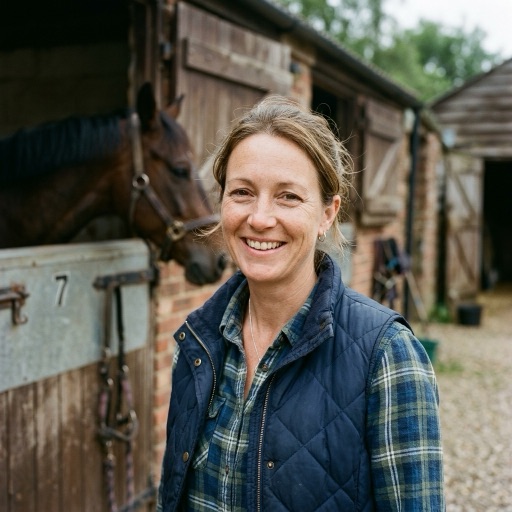
Emma has spent over thirty years around horses, from a Pony Club childhood on a borrowed Welsh cob to adult life combining low-level eventing, hacking and far too much time reading about training theory. She writes Gallopa's riding and horse fitness guides, and her rule for every piece is simple: if she would not act on it with her own horse, it does not get published.